



The Bowbazar gold market is Kolkata’s oldest and largest jewellery district, a dense cluster of showrooms, small family shops and hidden karigar workshops along Bepin Behari Ganguly Street (still called Bowbazar Street by almost everyone) in central Kolkata. It is where a large share of the gold sold across eastern India is designed, hand-finished and traded. Buyers come here for two reasons. The range is far wider than any single mall showroom, and making charges tend to be lower because the craftsmen work a few doors away from the counter rather than in another state. Expect making charges roughly in the 8 to 18 percent band for standard 22K pieces, plus 3 percent GST on the total value. Every legitimate piece must carry a BIS hallmark with a six-character HUID code that you can verify yourself. Most shops run from around 10.30 am to 8 pm, and the lanes are busiest through Durga Puja and the winter wedding season.
Why the Bowbazar gold market is different from a mall showroom
Kolkata is widely described as India’s jewellery manufacturing capital, and Bowbazar is the reason. Behind the shopfronts sits a warren of narrow lanes and first-floor rooms where karigars melt, draw, solder and polish gold by hand. Many of these artisans trace their families back to villages in Bengal that have supplied goldsmiths to the city for generations.
That proximity between workshop and counter changes what you can do as a buyer. You can commission a piece to a drawing, ask for an existing design in a lighter weight, get an old ornament melted and remade, or have a broken clasp repaired the same week. In a chain showroom you are choosing from finished stock. In Bowbazar you are much closer to the making process, which is exactly why serious bridal buyers still come here.
Where is Bowbazar and how do you get there?
Bowbazar sits in central Kolkata, roughly between Chandni Chowk and Sealdah. The main jewellery stretch runs along Bepin Behari Ganguly Street, with heavy concentration around the Bowbazar crossing and the lanes leading off it.
- By metro: Central and Chandni Chowk on the Blue Line are the closest stops, and Sealdah on the Green Line puts you a short ride away. If you are unsure which line to take, our Kolkata metro route guide breaks down each line and where it actually goes.
- By train: Sealdah station is walkable for many people, or a very short auto or taxi hop.
- By car: Possible but not recommended. Parking around the Bowbazar crossing is genuinely difficult and the lanes are narrow.
Go on a weekday morning if you want the shop owner’s attention. Weekend afternoons and the weeks before Durga Puja are crowded enough that a careful purchase becomes hard.
What to buy in Bowbazar
Bridal and heavy traditional sets
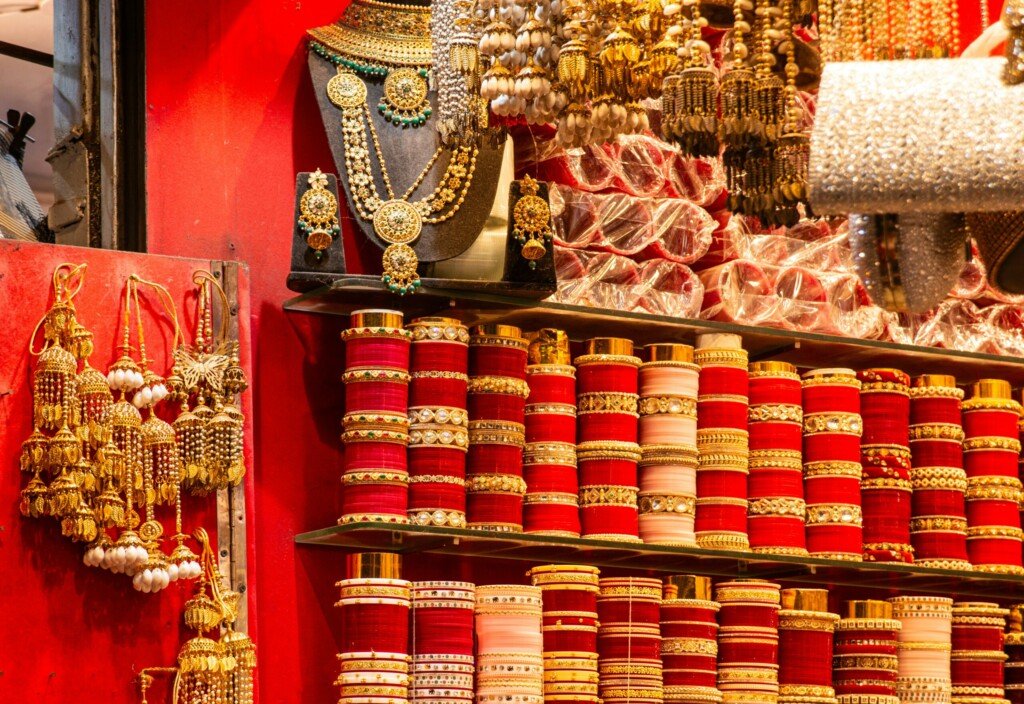
This is Bowbazar’s core strength. Bengali bridal jewellery has a distinct vocabulary: the tiara-like mukut, the sitahaar long chain, chur and bala bangles, the ratanchur hand harness and the nath nose ring. Traditional filigree and repousse work is done here at a level that is difficult to find in national chain stores, and you can usually ask for a design to be adapted rather than accepting stock exactly as displayed.
Everyday and lightweight gold
Thin chains, small studs, plain bangles and mangalsutras are widely available and are the pieces where the making-charge difference between Bowbazar and a big showroom is most noticeable in rupee terms relative to the weight.
Silver, remaking and repairs
Silver puja items, gift articles and children’s jewellery are sold across the market. Many shops also take in old gold to be melted and remade, and handle repairs such as re-soldering, re-polishing and resizing. Rates for these services vary a lot between shops, so ask two or three before committing.
How much does gold cost here? Understanding your final bill
The daily metal rate is not something an individual shop sets, so that part of the price will be broadly similar across the market and across the city. What varies is everything layered on top. A typical bill has four components:
- Metal value: the day’s rate for the relevant purity, multiplied by the net weight of gold.
- Making charges: commonly quoted as a percentage of metal value, or sometimes as a flat rupee figure per gram. Reported ranges for Kolkata typically sit around 8 to 18 percent, with plain machine-made chains at the lower end and intricate handmade bridal work well above it. Treat these as indicative and ask for the exact figure in writing.
- Wastage: an additional percentage some jewellers add to account for gold lost during crafting. Not every shop charges it separately, and where it is charged it should be disclosed on the bill, not buried in the total.
- GST: 3 percent on the value of the gold plus making charges, plus a separate charge for hallmarking.
If a piece contains stones, the stone weight should be billed separately and deducted from the gold weight. Paying gold rate on the weight of a stone is one of the most common ways buyers lose money. Because rates move daily and each shop quotes its own making charges, confirm the current figures directly before you commit rather than relying on any number published online.
How to check purity: BIS hallmark, 916 and the HUID code
Hallmarking is the single most important check, and it is now straightforward. BIS hallmarking is mandatory for gold jewellery across most of India, and since April 2023 the six-character alphanumeric HUID (Hallmark Unique Identification) code has been required as part of it.
A compliant piece carries three marks, usually laser-etched somewhere discreet such as the inside of a ring, the back of a pendant or a necklace clasp:
- The BIS logo (the triangular standard mark).
- The purity grade: 916 for 22K (91.6 percent pure), 750 for 18K, 999 for 24K.
- The six-character HUID, unique to that single article.
Verify it yourself before paying. Download the official BIS Care app or check on the Bureau of Indian Standards website, enter the HUID, and the registered jeweller, assaying centre and certified purity will come up. If the code does not resolve, or the shop is reluctant to let you check, walk away. A genuine Bowbazar jeweller will have no problem with you looking it up at the counter.
How to bargain in Bowbazar without getting it wrong
Bargaining here works differently from a clothing or handicraft market. The metal rate is fixed by the market and no honest jeweller will discount it, so pushing on that number only signals inexperience. The negotiable parts are making charges and wastage.
- Ask for the making-charge percentage before you fall in love with a piece, not after.
- Get quotes from two or three shops on a comparable design and weight. The spread will tell you what is reasonable that week.
- Ask whether wastage is charged on top of making charges. Sometimes a lower making charge hides a higher wastage figure.
- Ask the buyback and exchange policy in advance, and get it stated on the bill. Terms differ sharply between shops.
- Always take a proper GST invoice showing net weight, purity, making charges and HUID. Without it you have no recourse and no clean resale record.
The same principle of doing your homework before you walk in applies right across the city’s older markets. Our New Market guide and Burrabazar market guide cover the bargaining conventions in those areas.
Bowbazar vs Gariahat vs chain showrooms
Bowbazar gives you the widest selection, the strongest craftsmanship for traditional and custom work, and generally the most competitive making charges. The trade-off is that quality and service vary enormously between shops, so you need to do more of the verification work yourself.
Gariahat and the south Kolkata belt are more convenient if you live in that part of the city and want a familiar neighbourhood jeweller. National chain showrooms in malls offer standardised pricing, clear buyback terms and a calmer buying environment, but usually at higher making charges and with less design flexibility. For a first small purchase, a well-known name may be worth the premium. For a bridal set, Bowbazar’s range is hard to match.
If you are planning a wider shopping trip around the city, our Kolkata shopping guide to markets and malls maps out which area suits which kind of purchase, and the Bengali saree shopping guide pairs naturally with a jewellery run for wedding buyers.
Mistakes first-time buyers make
- Accepting a verbal price without a written breakdown of weight, purity, making charges and taxes.
- Paying gold rate on stone weight in a studded piece.
- Skipping the HUID check because the shop looks established.
- Buying 22K for a piece that will take daily knocks. 18K is harder and often the better choice for rings worn every day.
- Shopping in the last week before Puja, when the crowds make careful comparison almost impossible.
- Carrying large amounts of cash. Card and bank transfer are widely accepted and leave a record.
Frequently asked questions
Is gold cheaper in Bowbazar than in other parts of Kolkata?
The metal rate is essentially the same everywhere on a given day. What is usually lower in Bowbazar is the making charge, because manufacturing happens in the same lanes. On a heavy piece that difference can be meaningful, but you should compare quotes rather than assume it.
What are the timings of the Bowbazar gold market?
Most shops open somewhere between 10 am and 11 am and close around 8 pm to 8.30 pm. Individual shops keep their own weekly off day, so if you are travelling specifically to visit one jeweller, call ahead and confirm.
How do I verify a BIS hallmark on the spot?
Find the six-character HUID etched on the piece, open the BIS Care app on your phone and enter it. The app returns the registered jeweller, the assaying centre and the certified purity. Do this before payment, not after.
Can I get old gold jewellery melted and redesigned in Bowbazar?
Yes, this is standard practice and one of the market’s real advantages. Ask upfront how the old piece will be weighed and assayed, what deduction applies for impurities, and what the making charge will be on the new design. Get all of it on paper before handing anything over.
Is Bowbazar safe for shoppers?
It is a busy commercial district that is well policed and perfectly fine to visit during business hours. The usual crowded-market precautions apply: keep bags closed, avoid displaying purchases on the street, and prefer daytime visits. The real risk in a jewellery market is a bad bill, not a bad neighbourhood.
The bottom line
The Bowbazar gold market rewards buyers who arrive prepared. Know the day’s rate before you go, ask for making charges and wastage as separate line items, verify the HUID on your phone at the counter, and insist on a full GST invoice. Do that, and you get access to craftsmanship and design range that very few Indian cities can match, at prices that generally beat the mall showroom down the road.