



For more than a decade, the blue Sabuj Sathi bicycle has been a familiar sight on the roads outside Bengal’s schools, parked in long rows at the gate or weaving through village lanes and town traffic with a schoolbag on the carrier. That bicycle is getting a new name and a new look.
On Tuesday, September 29, Chief Minister Suvendu Adhikari formally launched the Sarathi scheme at Madhusudan Pal Chowdhury High School in Byantra, Howrah. Sarathi replaces Sabuj Sathi, the bicycle distribution programme started by the previous state government, and the state says 12.59 lakh students will receive cycles under it in the 2026-27 academic year.
What Changes Under the Sarathi Scheme
- Coverage this year: 12.59 lakh students across 8,228 schools. Government figures put the spread at 334 blocks and 125 municipalities and municipal corporations.
- Class 8 to be added: Cycles currently go to students from Class 9 upwards. The Chief Minister said Class 8 students will be included from the next financial year.
- New colour and logo: The cycles are now saffron instead of blue, and a new logo replaces the Biswa Bangla emblem that marked the old bicycles.
- Quality checks: The government says a three-tier quality control process now covers the frame, fork, mudguard and tyres of each cycle.
- Made in Bengal: Components were earlier brought in from Punjab and assembled in the state. The government now wants cycles fully manufactured in Bengal, and has invited manufacturers with an offer of land in Howrah and agreements to buy their output.
The Chief Minister also criticised the quality of bicycles bought under the earlier scheme, and said welfare schemes would not be scrapped but their flaws would be fixed.
Other School Announcements From the Launch
The Howrah event doubled as a platform for several announcements that matter to students and parents across Kolkata and the districts:
- Composite grant: Rs 300 crore has been released in one go as a composite grant to around 80,000 primary and higher secondary schools. Schools use this grant for day-to-day needs such as repairs, stationery and small upgrades.
- Allowance for girl students: The annual allowance for girl students will rise from Rs 1,000 to Rs 2,000 from 2027.
- Smartphone and tablet grant: The Rs 10,000 given to higher secondary students for a smartphone or tablet will not continue. The Chief Minister said a higher amount will be given instead for learning materials. The exact amount and process have not been announced yet.
- School upgrades: Smart classrooms, laboratories, libraries and playgrounds are being modernised in 800 schools this year, with 600 already approved and 200 awaiting approval.
- NCC, NSS and Bratachari: The government plans to bring back NCC, NSS and Bratachari (the folk dance and values movement started by Gurusaday Dutt in 1932) in schools.
- Uniforms: School managements, not the government, will decide the colour and brand of uniforms. The state says it will focus on quality.
- Teacher recruitment: A first-phase School Service Commission list of over 10,000 candidates has been published, according to the Chief Minister.
What It Means for Students in Kolkata
Inside Kolkata, most students reach school on foot, by bus or by Metro, so the bicycle scheme has always mattered more in the suburbs and districts. But a large share of the 12.59 lakh students live just outside the city, in Howrah, North and South 24 Parganas and Hooghly, where a cycle can cut a long daily walk to school down to minutes. For families there, the switch to Class 8 next year means one extra year of easier travel.
The composite grant and school upgrade plans will be felt in city schools too, especially in older government and government-aided schools in north and central Kolkata that have been waiting for repairs and lab equipment. If you are exploring higher studies after school, our guide to the best JEE, NEET and WBJEE coaching institutes in Kolkata is a good place to start.
Tips for Parents and Students
- Ask your school first. Distribution happens through schools, so the headmaster or class teacher is the best source for dates and eligibility.
- Check the cycle on the day you receive it. Test brakes, tyre pressure and the chain before riding home, and report any defect to the school quickly.
- Get a lock and a bell. Both are cheap and save a lot of trouble at crowded school gates and market roads.
- Ride safe. Keep to the left, avoid riding two on one cycle, and add a reflector or light if the route home gets dark early in winter.
- Keep school records updated. Scholarship and allowance payments usually depend on correct student details and bank information held by the school.
Frequently Asked Questions
What is the Sarathi scheme in West Bengal?
Sarathi is the new name for the state’s free bicycle scheme for school students, earlier called Sabuj Sathi. It was launched on September 29, 2026, in Howrah.
Who is eligible for a Sarathi bicycle?
Students from Class 9 upwards in eligible schools receive cycles this year. The Chief Minister said Class 8 students will be included from the next financial year. Your school will confirm the exact eligibility.
How many students will get bicycles in 2026-27?
12.59 lakh students across 8,228 schools, according to the state government.
Is the Rs 10,000 tablet money for higher secondary students continuing?
No. The Chief Minister said that grant will be replaced by a higher amount for learning materials. Details have not been announced yet.
The Bottom Line
The bicycle stays, but the name, the colour and the rules around it are changing. Sarathi will reach 12.59 lakh students this year, Class 8 joins the list from next year, and the state wants every cycle built in Bengal. Alongside it come a bigger allowance for girl students, a one-time composite grant for schools and the return of NCC and Bratachari. For parents, the practical step is simple: keep in touch with your child’s school, because that is where every one of these benefits will be delivered.
Sources: Chief Minister Suvendu Adhikari’s address at the Sarathi launch in Byantra, Howrah, on September 29, 2026, as reported by PTI (via ThePrint), with scheme coverage figures cross-checked against reports by UNI, The Statesman, Millennium Post and Free Press Journal.
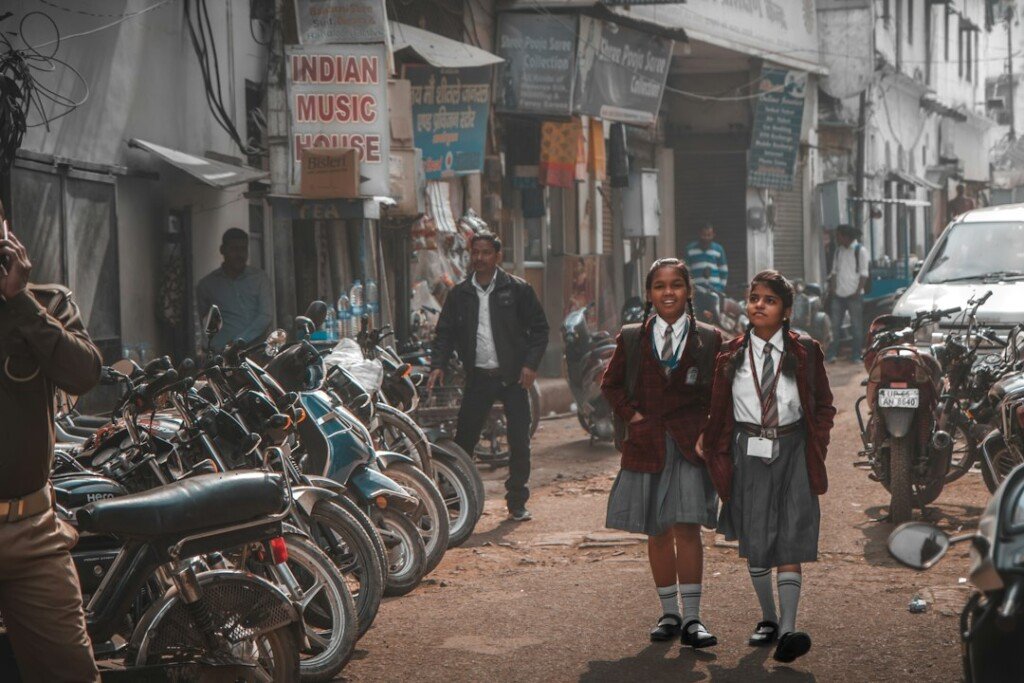
Featured image: School students in India, photo by Peter Chirkov on Unsplash.