


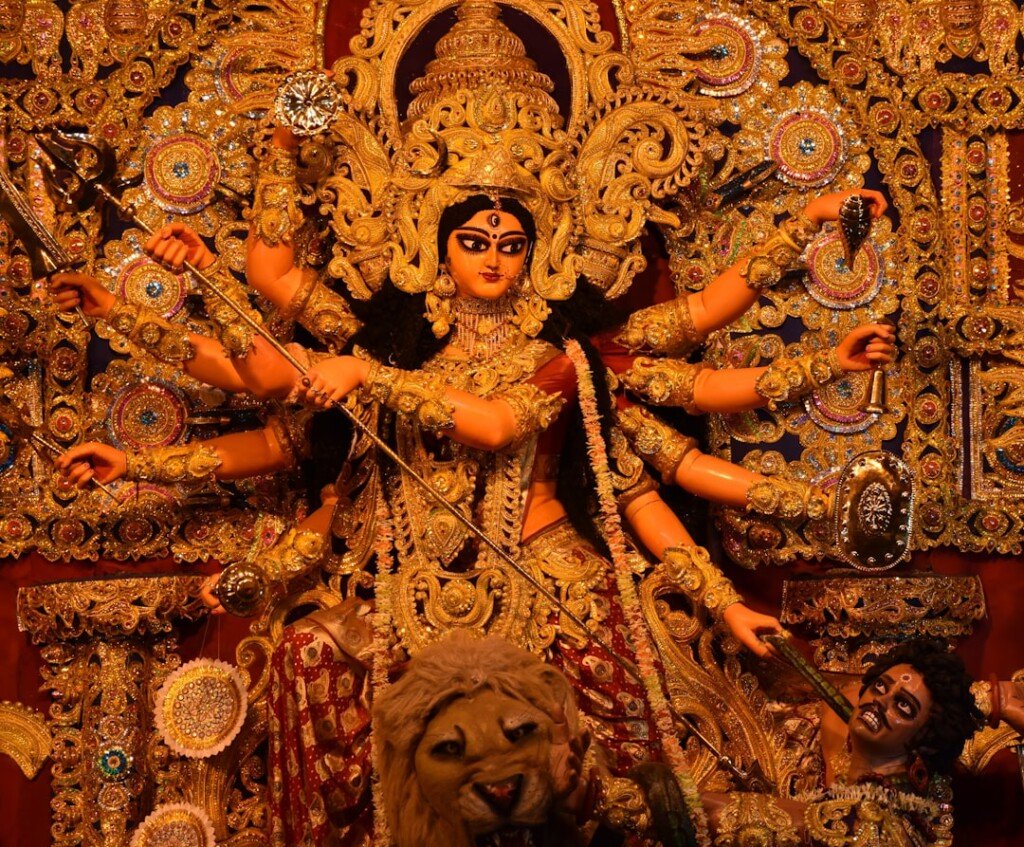

Bagbazar Sarbojanin Durga Puja is the oldest large community puja in Kolkata and the one that set the template for every “sarbojanin” (open to all) celebration that followed. It began in 1919 at 55 Bagbazar Street, when residents took over a family puja the Sarkar household could no longer afford, and it has been organised since the late 1920s by the Baghbazar Sarbojanin Durgotsav and Exhibition committee. What makes it worth a visit is everything the modern theme pandal is not: a traditional ekchala idol in the classic Bengal style, rituals performed without shortcuts, a large fair on the adjoining ground, a famous Dashami sindoor khela and an immersion procession to Bagbazar Ghat. This guide covers the history, what to see on each day, the nearest metro station and the practical details for a first visit.
History of Bagbazar Sarbojanin Durga Puja
The puja’s first year, 1919, was held at the Sarkar family home on Bagbazar Street under the name Nebubagan Baroyari Durga Puja, with local residents pooling money to keep it going. It moved locations several times over the next decade, to the junction of Bagbazar Street and Pashupati Bose Lane in 1924, to Kantapukur, and to the Bagbazar Kali temple in 1927. In 1926 the social reformer Narendra Nath Ghoshal, known as Dada Thakur, brought prominent citizens into the organisation and gave it a formal structure that other neighbourhoods copied. The exhibition that runs alongside the puja began in 1929, and in 1930 the Calcutta Municipal Corporation alderman Durgacharan Bandyopadhyay became president and expanded it, giving the committee its full name. Through the 1930s and 1940s the puja became closely associated with the Swadeshi movement, with the exhibition promoting Indian-made goods. The committee’s own site, bsde.org, documents this history.
The Idol and the Pandal
Bagbazar is one of the few big pujas that has resisted the theme-pandal trend. The idol is always a sabeki ekchala: the goddess and her four children on a single arched backdrop (chala), with the traditional daaker saaj (silver foil ornamentation) and the classic Bengali face. The pandal is a large, plain structure designed to frame the idol rather than compete with it. For visitors used to installation art, the effect is a reminder of what the festival looked like before sponsorship and awards. Photography is allowed from the public area, and the idol is best seen in the morning light or during the evening aarti.
What to See on Each Day
On Saptami morning the Nabapatrika (the nine plants that represent the goddess) is carried in procession from the pandal to the Ganga for its ritual bath and back. It starts early and is one of the most photogenic events in North Kolkata. The main morning pujas on Saptami, Ashtami and Navami are open to the public, and pushpanjali draws long, orderly queues, particularly on Ashtami. Sandhi Puja, at the junction of Ashtami and Navami, is performed with 108 lamps and is announced in advance at the pandal. The evening aarti with dhak and dhunuchi naach runs every night. On Dashami morning, after the Darpan Bisarjan, the sindoor khela is one of the largest in the city, with married women filling the pandal grounds. The immersion procession then travels to Bagbazar Ghat, a short distance away, and is watched from the road and the ghat steps.
The Bagbazar Fair
The mela on the ground next to the pandal is as much of an attraction as the puja for many families. It has stalls selling toys, handicrafts, household goods and food, along with rides and games, and it runs from the days before Panchami until after Dashami. The exhibition tradition continues in a modest way with stalls promoting local products. Food at the fair covers the standard Puja range: rolls, chops, phuchka, ice cream and Bengali sweets, plus sit-down counters for biryani and chowmein.
How to Reach Bagbazar Sarbojanin
The pandal is on Bagbazar Street in North Kolkata, close to the river. The nearest metro station is Shyambazar on the Blue Line, from which it is a 15-minute walk north-west along Bagbazar Street; Sovabazar-Sutanuti is a similar distance from the south. Buses along Bagbazar Street and the Chitpur Road stop at the pandal. The Bagbazar ferry ghat, a few minutes away, has services from Howrah and Belur; see our ferry routes guide. Driving is not practical during the festival. If you are staying in the North, the PG in North Kolkata guide covers Shyambazar and nearby areas.
Combining Bagbazar With Nearby Pujas
Bagbazar is the natural anchor of a North Kolkata route. Kumartuli Park, Kumartuli Sarbojanin and Ahiritola are a 10 to 15 minute walk south along the river, Sovabazar Rajbari is a little further, and the Hatibagan cluster (Nalin Sarkar Street, Kashi Bose Lane, Hatibagan Sarbojanin) is to the east near Shyambazar. The Kumartuli visitor guide explains how to see the idol workshops on the same walk. Our Durga Puja pandal hopping guide has the wider route.
Practical Tips
Mornings are the best time to see the rituals and the idol without crowds; evenings after 7 pm are for the fair and the aarti, with queues of 30 to 60 minutes on Ashtami and Navami. The pandal grounds are more open than most North Kolkata pujas, which makes it suitable for families and elderly visitors, though the lanes leading in are narrow. Toilets are set up on the fairground. Dress modestly if you plan to join anjali, and carry a small bag of flowers if you want to offer pushpanjali; the committee also provides them. Carry an umbrella in October.
Frequently Asked Questions
When did Bagbazar Sarbojanin Durga Puja start?
In 1919, at 55 Bagbazar Street, when local residents took over a family puja. It is regarded as Kolkata’s first major community puja and has been organised by the Baghbazar Sarbojanin Durgotsav and Exhibition committee since the late 1920s.
What is special about the Bagbazar Durga idol?
It is a traditional sabeki ekchala idol, with the goddess and her children on a single backdrop and silver-foil daaker saaj, unchanged in style for decades. Bagbazar does not do theme pandals.
Which metro station is nearest to Bagbazar Sarbojanin?
Shyambazar on the Blue Line, about 15 minutes on foot along Bagbazar Street. Sovabazar-Sutanuti is a similar walk from the south.
Where is the Bagbazar immersion held?
At Bagbazar Ghat on the Hooghly, a short procession from the pandal, on Dashami. The route along Bagbazar Street fills with spectators, and the ghat is visible from the road above.
Is the Bagbazar fair open every day of Durga Puja?
Yes. The mela runs from the days before Panchami through Dashami and usually a little beyond, with stalls, rides and food, and is busiest in the evenings.