



The best pandals in North Kolkata are the ones that show why the city’s Durga Puja earned UNESCO heritage status: Bagbazar Sarbojanin for its century-old traditional idol and fair, Kumartuli Park and Kumartuli Sarbojanin for pujas held in the potters’ quarter itself, Ahiritola Sarbojanin for ambitious theme pandals, and the Hatibagan cluster around Nalin Sarkar Street and Kashi Bose Lane for award-winning art on narrow lanes. Add Sovabazar Rajbari for a heritage family puja and Tala Prattoy for large-scale installation work, and you have a route that can be walked in one long evening from Shyambazar metro station. This guide lists each puja, what makes it worth the queue, the nearest metro stop and a walking order that keeps backtracking to a minimum.
Why North Kolkata Pandals Feel Different
North Kolkata is the old city. Its lanes are narrow, its houses are older, and its pujas are older still. Bagbazar Sarbojanin dates to 1919 and is regarded as Kolkata’s first true community puja; Ahiritola Sarbojanin started around 1940; Kumartuli has been making the idols for everyone else for more than two centuries. The result is a pandal-hopping experience built on tradition and craft rather than scale. You will see more sabeki (traditional) idols with the classic ekchala frame, more dhak, and more neighbourhood involvement than in the newer suburbs. The trade-off is crowd density: the lanes are tight, so the biggest pujas here can take an hour to enter on Ashtami and Navami nights.
Best Pandals in North Kolkata: The Essential List
Bagbazar Sarbojanin Durgotsav
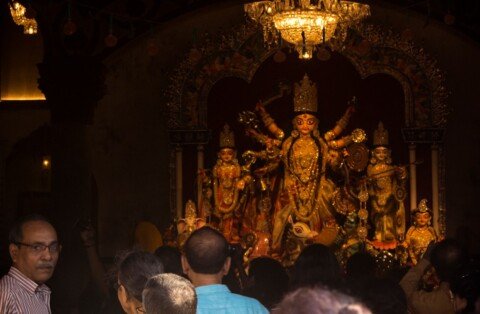
The anchor of any North Kolkata route. Bagbazar keeps a traditional ekchala idol year after year, runs a large fair (mela) on the adjoining ground and is famous for its Dashami sindoor khela and its immersion procession to Bagbazar Ghat. Expect long but orderly queues. Nearest metro: Shyambazar (Blue Line), then a 15-minute walk north along Bagbazar Street, or Bagbazar tram and bus stops on the doorstep.
Kumartuli Park and Kumartuli Sarbojanin
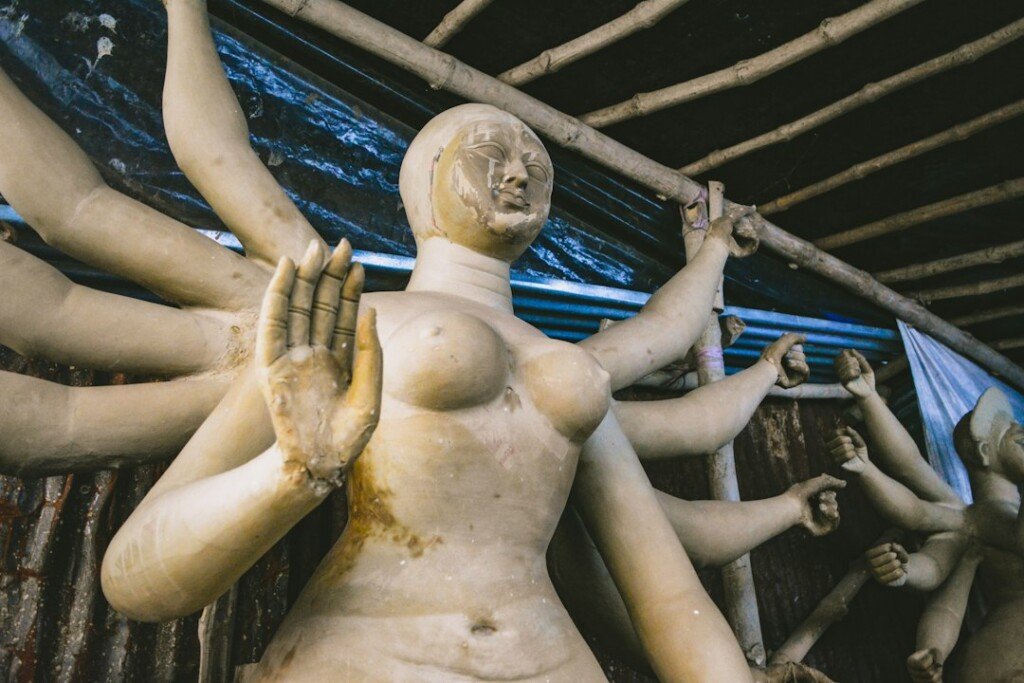
Two separate pujas in the potters’ quarter, both a short walk from Sovabazar-Sutanuti metro. Kumartuli Park is known for theme pandals that often draw on the craft of the neighbourhood; Kumartuli Sarbojanin is the more traditional of the two. The real bonus is the setting: the workshops that made half the idols in the city are on the same lanes, and you can see unfinished idols waiting for buyers even during the festival. Our Kumartuli visitor guide explains the best time to walk the lanes and the etiquette for photography.
Ahiritola Sarbojanin
One of the most consistent award-winners in the North, Ahiritola builds a new theme each year with strong art direction and is a regular in the Asian Paints Sharad Shamman lists. It sits near the river, close to Ahiritola Ghat, about ten minutes on foot from Sovabazar-Sutanuti metro. Go early: the entry lane is narrow and the queue can stretch to the main road after 8 pm.
Hatibagan Sarbojanin and Nalin Sarkar Street
Hatibagan Sarbojanin, at 48A Nalin Sarkar Street near the Star Theatre, is the heart of a dense cluster. Nalin Sarkar Street Sarbojanin next door has produced some of the city’s most talked-about theme pandals, often turning the lane itself into part of the installation. Both are a five-minute walk from Shyambazar metro. Combine them with Hatibagan Market, which stays open late for Puja shopping.
Kashi Bose Lane Durga Puja
A short walk from Hatibagan, Kashi Bose Lane is known for socially themed pandals and careful craftsmanship, and it draws serious crowds despite its small footprint. Its themes frequently address environmental or civic issues, and the pandal is usually one of the more thoughtful stops on the North route.
Sovabazar Rajbari
Not a community pandal but a bonedi bari, a heritage family puja that has run since 1757 in the courtyard of the Deb family mansion. Visitors are welcome during set hours. The idol is traditional, the rituals are the main draw, and photography rules are stricter than at club pujas. It is two minutes from Sovabazar-Sutanuti metro and pairs naturally with Kumartuli.
Tala Prattoy
Further north, near Tala Park, Tala Prattoy has become one of the most ambitious installation-style pujas in the city, with large immersive structures designed by well-known artists. It is a bus or auto ride from Shyambazar (or a walk of around 25 minutes) and is worth the detour if you have a full evening. Nearby Tala Barowari is the traditional counterpart.
Also Worth a Stop
Jagat Mukherjee Park (near Shyambazar, known for creative themes), Beniatola and Nimtala lanes near the river, and the Baghbazar Ghat area during immersion. If you are staying in the North, the PG in North Kolkata guide explains the neighbourhoods.
A One-Evening Walking Route
Start at Shyambazar metro around 5 pm, before the peak. Walk to Hatibagan Sarbojanin and Nalin Sarkar Street, then Kashi Bose Lane. Continue north-west to Bagbazar Sarbojanin, allow an hour there including the fair, and head south along the river to Kumartuli Park, Kumartuli Sarbojanin and Ahiritola. Finish at Sovabazar Rajbari and exit from Sovabazar-Sutanuti metro. The whole loop is about four kilometres of walking, which with queues takes five to six hours. Tala Prattoy is best done on a separate evening or first, by bus from Shyambazar, before joining the loop. For station details see the Kolkata Metro route guide.
When to Go and What to Expect
Panchami and Shashthi evenings are far calmer than Ashtami and Navami. Early morning on Saptami offers the Nabapatrika procession at Bagbazar and near-empty lanes. Most North Kolkata pandals do not have large parking areas, so avoid driving. Food is easy: the lanes around Hatibagan and Bagbazar fill with rolls, chops and tea stalls, and the Bagbazar fair has its own food section. Toilets are limited; use the ones at metro stations or the temporary blocks set up by the larger committees. Traffic diversions for the North are published each year by Kolkata Police.
Frequently Asked Questions
Which is the oldest community Durga Puja in North Kolkata?
Bagbazar Sarbojanin Durgotsav, which began in 1919, is widely regarded as Kolkata’s first large community (sarbojanin) puja. Sovabazar Rajbari’s family puja is older still, dating to 1757, but it is a household puja rather than a community one.
What is the nearest metro station for North Kolkata pandals?
Shyambazar and Sovabazar-Sutanuti on the Blue Line cover almost every major North Kolkata pandal. Belgachia serves the Tala area, and Girish Park serves the southern end near Beadon Street.
How long does it take to see the North Kolkata pandals?
A full loop of the main pujas takes five to six hours on foot including queues on a busy evening. On Panchami or Shashthi, or early in the morning, the same route can be done in three hours.
Are North Kolkata pandals suitable for children and senior citizens?
Yes, with planning. The lanes are narrow and crowds are dense after 7 pm, so visit before 6 pm or early in the morning. Bagbazar and Kumartuli Park have more open space than the Hatibagan cluster.
Can visitors enter Sovabazar Rajbari during Durga Puja?
Yes. The Deb family opens the courtyard to visitors during puja hours, particularly during morning rituals and the evening aarti. Dress modestly, follow the family’s photography rules and do not touch the idol platform.