


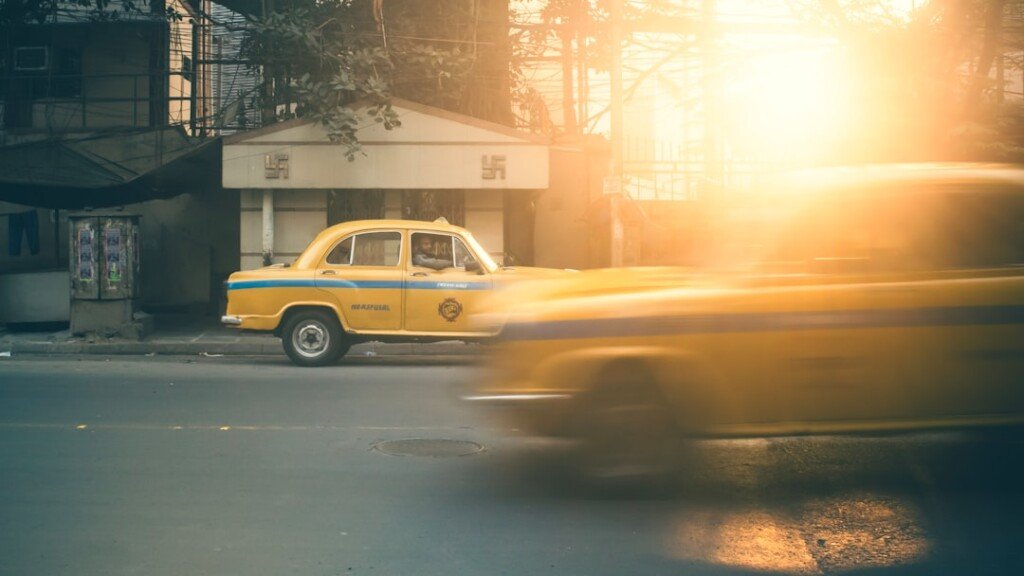

Kolkata auto and taxi fares vary widely depending on where you are going and which mode you choose. Shared autos on fixed routes typically cost somewhere in the range of Rs 10 to Rs 30 per head for short hops of two to five kilometres, since drivers split a flat per-route fare among passengers rather than running a meter. Yellow taxis are metered, and going by the tariff card used across the city they tend to work out to a base fare for the first kilometre plus a smaller per-kilometre rate after that, though most drivers today prefer app-based bookings over the meter. App cabs such as Ola, Uber, inDrive, and the government’s own Yatri Sathi app price rides dynamically by distance, traffic, and demand, and are usually the most predictable option if you want an upfront estimate. Prepaid taxi booths at the airport and Howrah station remove the haggling entirely by fixing the fare in advance.
How Shared Autos Work in Kolkata
Most of Kolkata’s autos do not roam freely looking for passengers. They run on fixed, government-permitted routes, usually a stretch of two to six kilometres between two well-known points such as a Metro station and a market, or a bus terminus and a residential pocket. Drivers wait at a designated stand until the three-seat rear bench fills up, then set off and drop each passenger along the route for a flat, pre-agreed fare. Because the fare is per head and per route rather than per kilometre, it barely changes with traffic, though a late-night or off-route request can cost more since you are effectively booking the whole auto.
If you are new to a route, the simplest way to know the going rate is to watch what the passenger ahead of you hands over, or simply ask. Auto unions in each zone set their own fares, and these are revised periodically, so treat any number you read online (including this one) as a starting estimate rather than gospel.
Kolkata Auto Fares by Zone
Broad patterns hold across the city, even though exact figures shift route by route:
- South Kolkata (Gariahat, Ballygunge, Jadavpur, Garia): A dense network of short auto routes links Metro stations to residential lanes and markets. Typical shared fares run roughly Rs 10 to Rs 20 for a two to four kilometre hop.
- North Kolkata (Shyambazar, Hatibagan, Sealdah): Similar short, high-frequency routes connect the older neighbourhoods; fares are generally comparable to South Kolkata for similar distances.
- Salt Lake and New Town: Autos here often cover slightly longer stretches between sector gates, Metro stations, and IT office clusters, so fares tend to run a little higher than the older parts of the city.
- Howrah side: Routes from Howrah Station fan out toward local neighbourhoods and connecting transport hubs, with fares generally in line with the rest of the city for comparable distances.
For an exact, current fare on a specific route, the most reliable approach is still to ask at the auto stand itself. Rates get revised by local unions from time to time, and a figure that was accurate a year ago may already be out of date.
Yellow Taxi and Metered Fares
Kolkata’s iconic yellow Ambassador-style taxis technically run on a government-approved meter tariff, with a base fare covering the first kilometre and a smaller incremental charge for every kilometre after that, plus waiting charges and a night surcharge in some cases. In practice, many drivers now prefer a pre-negotiated fare or a booking through the Yatri Sathi app rather than switching the meter on, especially for longer or off-peak trips. If you do want the official metered rate, the Kolkata Traffic Police publishes the current tariff card, and it is worth a quick check before you travel since fares are revised periodically.
Prepaid Taxi Booths: Airport, Howrah and Sealdah
The easiest way to avoid any fare dispute is to use a prepaid taxi booth, run by the West Bengal Transport Department at Netaji Subhas Chandra Bose International Airport, Howrah Station, and Sealdah Station. You tell the counter your destination, pay a fixed amount on the spot, and hand the receipt to the driver at the end of the ride. As a rough guide, a standard yellow-taxi prepaid ride from the airport into central Kolkata (a roughly 25 kilometre trip) has recently run somewhere in the range of a few hundred rupees, with air-conditioned cabs costing noticeably more; treat this only as a ballpark and confirm the current rate at the counter, since it is adjusted from time to time and also carries a small out-of-city surcharge when applicable.
App-Based Cabs and Autos: Ola, Uber, inDrive and Yatri Sathi
Ola and Uber operate normally across Kolkata, with dynamic pricing that rises during rain, rush hour, and major events like Durga Puja. inDrive, where you and the driver negotiate a price before confirming, has also picked up a following for its transparency. The state government’s own Yatri Sathi app is worth trying if you want to skip third-party commissions and surge pricing altogether: it lets you book cabs, bike taxis, and even government buses, with fares set by the operator model rather than a surge algorithm. For airport and station pickups in particular, an app-based booking or a prepaid counter is usually less hassle than hailing a taxi on the street.
Tips to Avoid Overpaying
- Ask a local or a fellow passenger what the standard fare is before you board a shared auto.
- Agree on the fare with a taxi driver before the trip starts if the meter isn’t being used.
- Use the prepaid booth at the airport, Howrah, or Sealdah rather than negotiating on the street.
- Compare the on-screen estimate from Ola, Uber, or Yatri Sathi before confirming a ride, especially during rain or rush hour when surge pricing kicks in.
- Keep small change handy. Shared auto fares are usually round numbers, and drivers often can’t break large notes.
Frequently Asked Questions
How much does a Kolkata auto rickshaw cost?
Shared autos on fixed routes generally cost somewhere around Rs 10 to Rs 20 per head for a short two to four kilometre stretch, though exact fares vary by route and are set by local auto unions rather than a citywide meter.
Are Kolkata taxis metered or fixed-fare?
Yellow taxis technically run on a government-approved meter, but in practice many drivers prefer a pre-negotiated fare or an app booking. If you want the official metered rate, check the current tariff card published by the Kolkata Traffic Police.
What is Yatri Sathi and is it cheaper than Ola or Uber?
Yatri Sathi is the West Bengal government’s own ride-booking app for cabs, bike taxis, and buses. It was built to remove surge pricing and driver commissions, so it can work out cheaper than private apps during peak demand, though base fares are broadly comparable during normal hours.
How do prepaid taxi booths work at Kolkata airport?
You tell the counter staff your destination, pay a fixed fare on the spot, and get a receipt to hand to your allotted driver. This removes any need to negotiate and is the recommended option for first-time visitors arriving late at night.
Can I negotiate auto fares in Kolkata?
On fixed shared routes, fares are generally standard and non-negotiable since you are one of several passengers. If you book an auto or taxi privately for a custom route, agreeing on the price before you get in is standard practice and expected by drivers.
For more on getting around the city, see our guides to the Kolkata Metro, Bus, Ferry and Auto system, the Kolkata Metro route map, the Kolkata bus route finder, and ferry routes across the Hooghly. For the official metered taxi tariff, check the Kolkata Traffic Police fare chart, and for prepaid booth locations, see the West Bengal Transport Department’s prepaid taxi booth page.