


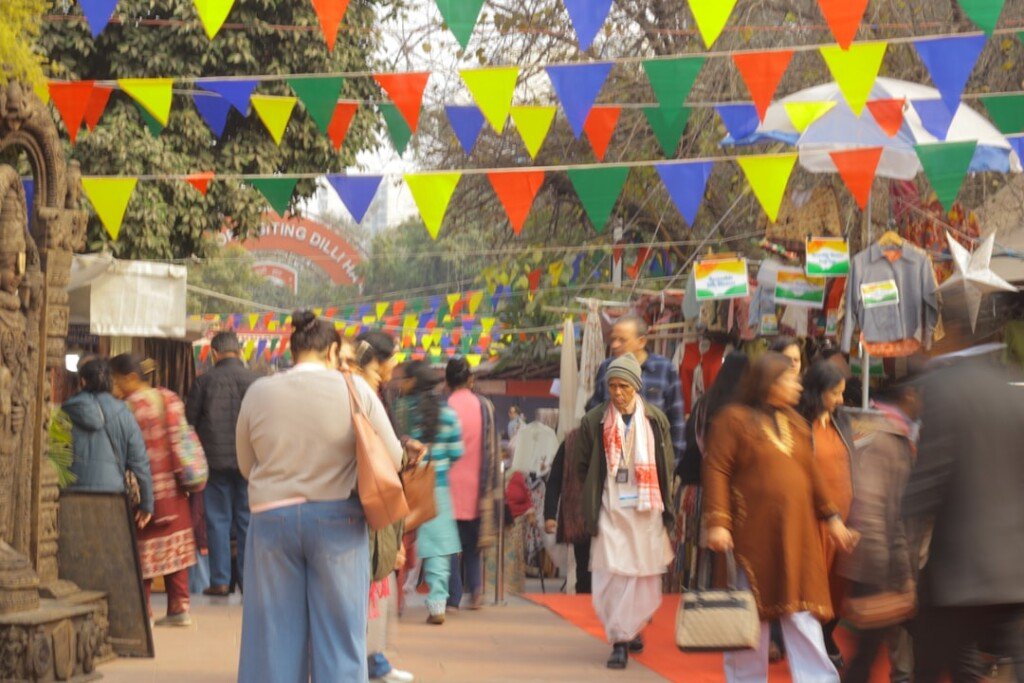

Dakshinapan Kolkata is a government-built, open-air shopping complex in Dhakuria, South Kolkata, where more than a dozen state handloom and handicraft emporiums sit together with Bengal’s own Biswa Bangla store, a khadi outlet and the city’s original tea bar, Dolly’s. It is the place to go when you want a Chanderi or Sambalpuri saree, Kalamkari fabric, Dokra figures, Mysore sandalwood or Assamese silk at fixed government prices, without the haggling of Gariahat or New Market. The complex stands at 2 Gariahat Road South, at the foot of the Dhakuria rail overbridge, a few hundred metres from Dhakuria railway station and roughly 1.5 km from Rabindra Sarobar metro on the Blue Line. Most shops open between 10:30 AM and 11 AM and close by 7:30 PM or 8 PM. The whole complex is closed on Sundays, and many shops open only after about 2:30 PM on Mondays, so plan a Tuesday to Saturday visit.
What Is Dakshinapan and Why Is It Different from Other Kolkata Markets?
Dakshinapan Shopping Centre was launched in 1988 by the Kolkata Improvement Trust as a planned alternative to the city’s street bazaars. It spreads across roughly 57,000 square feet on two levels around open courtyards, with about 141 shop units. The idea was simple: bring the official emporiums of India’s state governments, which sell handloom and handicraft made by rural artisans, to a single South Kolkata address. Nearly four decades on, that is still the draw. The complex also houses Madhusudan Mancha, an auditorium that stages theatre, dance and recitals, so on some evenings the courtyards fill with a theatre crowd as well as shoppers.
Three things separate Dakshinapan from the rest of Kolkata’s shopping scene. First, prices at the state emporiums are fixed and tagged, so there is no bargaining and no risk of being overcharged. Second, provenance is reliable: a Patola from Gurjari or a Chanderi from Mrignayani is what the label says it is. Third, it is unhurried. Compared with the crush of Gariahat’s pavement stalls or the lanes of New Market, Dakshinapan on a weekday afternoon is almost quiet.
Dakshinapan Timings: Opening Hours and Weekly Closing Day
There is no single gate time; each shop keeps its own hours, but they cluster tightly. Most emporiums open between 10:30 AM and 11 AM and close between 7:30 PM and 8 PM from Tuesday to Saturday. Dakshinapan is closed on Sundays. Monday is a half day for many shops, with several opening only around 2:30 PM, so a Monday morning trip usually ends in disappointment. Individual emporiums may also shut for public holidays of their home state. Timings do change, so confirm with the specific shop before making a special trip for it.
- Tuesday to Saturday: roughly 11 AM to 8 PM (a few shops open at 10:30 AM or close at 7:30 PM)
- Monday: many shops open only from about 2:30 PM
- Sunday: closed
- Dolly’s Tea Shop: roughly 10:30 AM to 7:30 PM
How to Reach Dakshinapan Kolkata by Metro, Train, Bus and Cab
The address is 2 Gariahat Road South, Dhakuria, Kolkata 700068. The complex sits beside Gariahat Road right where the road climbs onto the Dhakuria bridge (Sri Chaitanya Mahaprabhu Setu), between Gariahat to the north and Jadavpur to the south. Ask anyone in the area for “Dakshinapan” and they will point you to it.
By Metro
The nearest station is Rabindra Sarobar on the Blue Line (Dakshineswar to Kavi Subhash), about 1.5 km to the west. From the station, take an auto or any bus heading towards Gariahat or Dhakuria, or walk for around 20 minutes along Southern Avenue and Gariahat Road. Kalighat station is the alternative if you are coming from the north and want to combine the trip with a visit to Kalighat temple. Current first and last train timings are published by Metro Railway Kolkata.
By Local Train
Dhakuria station on the Sealdah South section is the closest rail stop, only a few hundred metres from the complex. Trains from Sealdah via Ballygunge take around 15 to 20 minutes and continue to Jadavpur, Garia and beyond. Leave the station, walk to Gariahat Road and follow the bridge approach down to the complex. Our Kolkata local train guide explains the Sealdah South lines, fares and tickets.
By Bus, Auto or App Cab
Any bus running along Gariahat Road towards Jadavpur or Garia passes the complex; ask for the Dhakuria bridge stop. Autos run from Gariahat crossing and from the 8B stand at Jadavpur, both of which pass Dakshinapan. App cabs will drop you at the Gariahat Road entrance. Parking is limited and the stretch is congested in the evening, so a cab is easier than driving.
State Emporiums at Dakshinapan: What Each One Is Known For
The state emporiums are the reason to come. Here is what to look for in the main ones, grouped by region. Shop numbers change occasionally, so check the directory board near the entrance.
Bengal and Khadi: Biswa Bangla, Tant Ghar and Khadi Gramodyog Bhavan
Biswa Bangla is the West Bengal government’s own retail brand and stocks Jamdani, Santipuri and Baluchari sarees, along with Bolpur wooden owls, Bishnupur Dokra, Chitpur attar and jars of nolen gur. It is the best one-stop shop in the complex for Bengal gifts. Tant Ghar sells everyday Bengal handloom cotton sarees, bedsheets and salwar suits at modest prices, and Khadi Gramodyog Bhavan carries khadi kurtas, fabric by the metre and toiletries, with discounts around national holidays. For the same crafts elsewhere in the city, see our guides to traditional Bengali sarees and Bengali handicrafts in Kolkata.
West and North India: Gurjari, Rajasthali and Phulkari
Gurjari, the Gujarat emporium, is the place for Bandhani, Patola and Gharchola sarees, Bandhani dupattas and mirror-work home decor. Rajasthali, from Rajasthan, is popular for hand-block-printed quilts, bedsheets and sarees, puppets, brass, wood and stone idols and costume jewellery; prices are on the higher side but quality is consistent. Phulkari, run by the Punjab government, sells the embroidered dupattas, jackets, kurtis and bags the name suggests, plus Ludhiana shawls and Amritsar blankets.
South India: Poompuhar, Cauvery and Lepakshi
Poompuhar, the Tamil Nadu emporium on the first floor, carries brass and bronze figures and geometric-patterned rugs, curtains and bed linen. Cauvery, from Karnataka, is where Kolkata buys Mysore sandalwood, sandal soap, incense sticks, rosewood carvings and Bidriware. Lepakshi, the Andhra Pradesh emporium, has Kalamkari fabric and paintings from Pedana and Machilipatnam, wooden toys, bamboo and palm-leaf goods, stone carvings and Tanjore-style art.
East and Northeast: Utkalika, Pragjyotika and Panthoibi
Utkalika, from Odisha, sells Sambalpuri, Bomkai and Nuapatna cotton sarees, paintings, silver filigree from Cuttack and sandstone and granite carvings. Pragjyotika, the Assam emporium, is one of the most affordable shops in the complex, with silk and cotton Mekhela Chador sets, Assam tea, gamchas, jaapi hats, wooden rhinos, Naga shawls, pickles and honey. Panthoibi, the Manipur emporium on the first floor, stocks Manipuri handloom, kauna reed mats and cushions and hand-coiled pottery.
Central and North India: Mrignayani and Lucknow Chikan
Mrignayani, the Madhya Pradesh emporium, is the saree stop for Chanderi weaves and also carries Tussar, Mangalgiri and Gadwal, plus ethnic silver jewellery and home furnishings. It is one of the pricier emporiums, with sarees starting in the low thousands. Lucknow Chikan Factory, a private outlet rather than a state store, does chikankari kurtis and long dresses in a range that few shops in the city match, and sells wholesale as well as retail.
Between the emporiums are private boutiques worth a look: Kalap for readymade blouses in cotton, tussar and brocade, Mohar for well-draped cotton sarees, and Aranya for kantha bags, hand-painted enamelware and hand-bound notebooks that make easy gifts.
What to Buy at Dakshinapan and How Much It Costs
Prices are fixed and clearly tagged, which makes budgeting easy. The figures below are rough starting points reported by recent visitors. Stock and rates change, so treat them as guidance rather than quotes and confirm at the counter.
- Handloom cotton sarees (Tant, Sambalpuri, Mangalgiri): typically from around Rs 1,000
- Silk and premium handloom (Chanderi, Patola, Baluchari, Mekhela Chador): from roughly Rs 3,000 upward, with Patola and Baluchari running far higher
- Dokra, brass and stone figures: from a few hundred rupees for small pieces
- Sandalwood products, incense and Mysore sandal soap: from about Rs 100 to Rs 700
- Block-printed quilts and bedsheets: from roughly Rs 500 to Rs 2,000
- Assam tea, pickles, honey and small crafts: from about Rs 100
- Readymade blouses and kurtis: from around Rs 200 at boutiques, Rs 2,500 and up for chikankari
Best value buys are Bengal tant sarees, Assam tea and handicrafts, khadi fabric and sandalwood products. The splurges worth making are a Patola or Baluchari saree and a Chanderi silk, none of which you will find cheaper or more reliably sourced elsewhere in the city.
Dolly’s Tea Shop: Where to Take a Break
Dolly’s, The Tea Shop (shop G-62) opened in 1988 alongside the complex and is widely credited with introducing the “tea bar” to Kolkata. Its founder, Dolly Roy, was India’s first woman tea taster and travelled the world as a Tea Board ambassador in the 1970s. She died in 2023, and the shop carries on. Order a Darjeeling first flush without milk, an iced Mango Tango in summer, and a ham or chicken sandwich or fish fry to go with it. Expect to spend roughly Rs 400 to Rs 600 for two. Loose tea is sold to take home. Rajdhani Chaat, near the entrance, does kachori and chaat if you want something quicker.
Dakshinapan vs Gariahat vs New Market: Which Should You Choose?
Choose Dakshinapan when you want authentic handloom and crafts from outside Bengal, a fixed price and a calm afternoon. Choose Gariahat for the widest range of Bengal sarees at every price point and the fun of bargaining. Choose New Market for imported goods, leather, dry fruit and everything under one roof. Many shoppers pair Dakshinapan with Gariahat, a 10 minute ride north, in a single afternoon. Our Kolkata shopping guide compares every major market and mall in the city.
Tips for a Good Visit
- Go Tuesday to Saturday, ideally between 11:30 AM and 6 PM, when every shop is open and the courtyards are pleasant.
- Carry a card or UPI. The emporiums accept both, though one or two small boutiques still prefer cash.
- Ask for the Handloom Mark or Silk Mark tag on premium sarees; the state emporiums usually have them.
- Check the exchange policy at the counter. Government emporiums generally do not take back cut fabric or sale items.
- Go upstairs. Several of the best shops, including Panthoibi, Poompuhar and Aranya, are on the first floor and easy to miss.
- Time it with the Puja sales. Many emporiums run discounts in the weeks before Durga Puja; our Durga Puja shopping guide covers what to buy where in those weeks.
Frequently Asked Questions About Dakshinapan Kolkata
Is Dakshinapan open on Sunday?
No. The complex is closed on Sundays. Many shops also open late on Mondays, at around 2:30 PM, so Tuesday to Saturday is the safe window.
Which metro station is nearest to Dakshinapan?
Rabindra Sarobar on the Blue Line, about 1.5 km away, followed by Kalighat. Dhakuria railway station on the Sealdah South line is much closer, only a few hundred metres from the entrance.
Can you bargain at Dakshinapan?
No. State emporiums sell at fixed, tagged prices. A private boutique may offer a small discount on a large purchase, but haggling is not the culture here, which is a large part of the appeal.
What is Dakshinapan famous for?
Its cluster of state government emporiums selling authentic handloom and handicrafts from across India, the Biswa Bangla store for Bengal products, Madhusudan Mancha auditorium and Dolly’s Tea Shop, which pioneered the tea bar in Kolkata.
Is Dakshinapan good for Durga Puja shopping?
Yes, particularly for sarees and gifts, and especially if you want handloom from other states such as Chanderi, Sambalpuri or Bandhani. Expect pre-Puja discounts at several emporiums and noticeably larger crowds in the two or three weeks before the festival.